Architecture / Infrastructure DesignAug 2025
System Architecture & Design
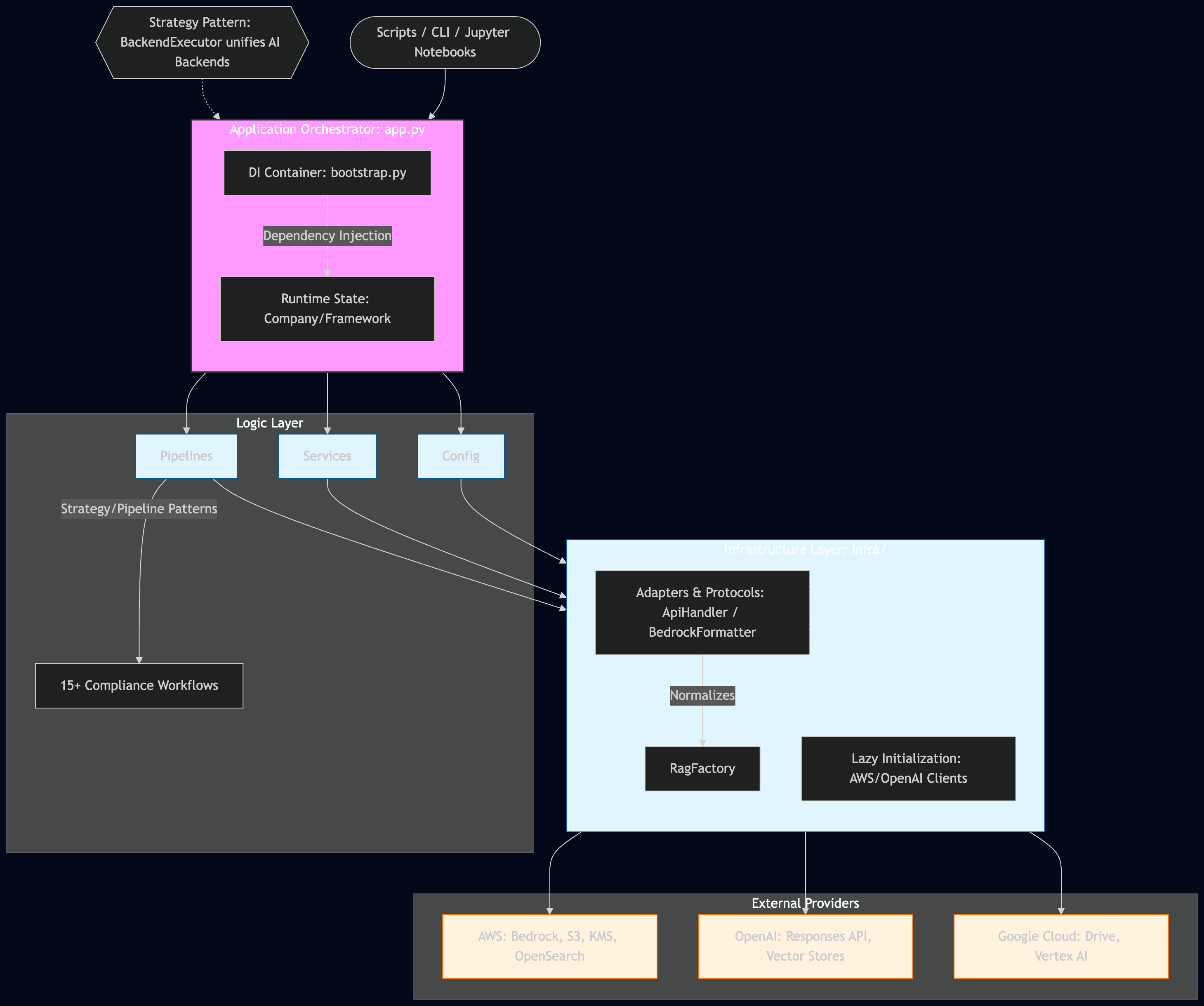
A high level architecture diagram of the compliance automation platform. Orchestration layer, DI, strategy based backend execution, logic pipelines, adapter protocols, and external provider integrations, all laid out.
Problem
AI platforms with a pile of pipelines fall apart without clear architectural boundaries. You want new workflows to go in without breaking old ones, and you want tests that don't require spinning up the whole platform.
Solution
Designed a layered architecture. Central orchestrator. DI container. Strategy pattern for backend execution. Adapter protocols that keep business logic off the concrete details of AWS, OpenAI, and Google Cloud.
Impact
- →Clean separation between orchestration, logic, and infrastructure layers
- →15 plus compliance workflows share the same pipelines, services, and config
- →External provider integrations are fully decoupled through adapter protocols and lazy init
Architecture
- 01Application Orchestrator (app.py) bootstraps the DI container and runtime state
- 02BackendExecutor uses the strategy pattern to unify AI backend calls
- 03The Logic Layer organizes Pipelines, Services, and Config for 15 plus compliance workflows
- 04Adapters and Protocols (ApiHandler, BedrockFormatter) normalize how the system talks to the outside
- 05RagFactory and lazy initialized AWS and OpenAI clients sit at the infrastructure layer
- 06External providers (AWS, OpenAI, Google Cloud) plug in through decoupled integrations
Capabilities
- ·Application orchestration with DI container
- ·Strategy pattern for unified backend execution
- ·Adapter and protocol layer for API handlers
- ·RagFactory for retrieval integration
- ·Lazy initialization of cloud clients
- ·Multi provider external integration
Stack
PythonAWS (Bedrock, S3, KMS, OpenSearch)OpenAI (Responses API, Vector Stores)Google Cloud (Drive, Vertex AI)Dependency InjectionStrategy Pattern